Plaice
Pleuronectes platessa
Plaice (Pleuronectes platessa) is a saltwater fish found in UK waters. Clean sand and fine gravel, often near mussel beds and banks. Inshore in spring and summer. Whether you can keep one depends on local rules — check before you do.
- Max length
- 90 cm
- Max weight
- 7 kg
- Water
- Saltwater
- How often
- Common
Updated
What it looks like
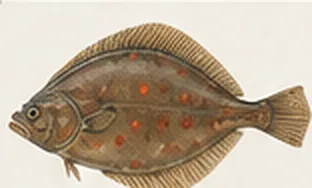
A right-eyed flatfish: brown above, brilliant white below, and scattered with unmistakable bright orange-red spots. The upper side is smooth with a bony ridge behind the eyes.
Plaice start life as normal upright fish; during development one eye migrates across the skull and the fish settles onto its left side. Everything about the adult — the colour, the fringe of fins, the flattened body — is built for lying still on sand.
How to catch one
Bait
Ragworm and lugworm, often tipped with a strip of squid. Beads and sequins above the hook help.
Rig
A flowing trace on a running leger, with attractor beads just above the bait.
When
A moving tide over clean ground.
Where
Sandbanks, mussel beds and the edges of channels.
Season: Spring into summer inshore.
Easy to confuse with
flounder
Flounder are duller, lack the bright orange spots and have rough tubercles along the lateral line.
dab
Dab are smaller, rougher to the touch and have a distinctly curved lateral line over the pectoral fin.
Questions anglers ask
- Why do plaice have orange spots?
- They are camouflage and species recognition. The pattern breaks up the outline against sand and gravel.
- What is the best bait for plaice?
- Ragworm or lugworm tipped with squid, fished over clean ground with a few attractor beads above the hook.