Perch
Perca fluviatilis
Perch (Perca fluviatilis) is a freshwater fish found in UK waters. Almost everywhere in fresh water — rivers, canals, lakes and reservoirs. Sits tight to structure: bridge supports, moored boats, reed edges, drop-offs. Whether you can keep one depends on local rules — check before you do.
- Max length
- 60 cm
- Max weight
- 4.8 kg
- Water
- Freshwater
- How often
- Very common
Updated
What it looks like
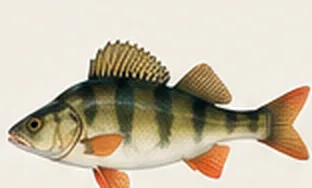
Unmistakable: a deep olive-green body crossed by five to nine dark vertical bars, a humped back, and bright orange-red pelvic and anal fins. The first dorsal fin is a spiny sail with a dark spot at the rear.
Small perch are slim and boldly striped; big ones develop a pronounced hump behind the head and the stripes fade into a darker, bronzier body. Handle with care — those dorsal spines are sharp and the gill plates have an edge.
How to catch one
Bait
Worms and small livebait, or lures — small jigs, spinners and drop-shot rigs.
Rig
A light float rig with worm, or a drop-shot setup with a 2–3 inch soft plastic.
When
Low light. Overcast days, dawn and the last hour before dark.
Where
Any hard edge or structure. Perch ambush, so fish the seam rather than open water.
Season: All year. Autumn and early winter produce the biggest fish as they shoal up.
Easy to confuse with
ruffe
Ruffe are much smaller, mottled rather than barred, and have a single joined dorsal fin.
Questions anglers ask
- Are perch good to eat?
- They are considered excellent eating across Europe, but most UK fisheries are catch-and-release. Check local rules first.
- What is the best bait for perch?
- A lobworm is hard to beat for numbers. For bigger fish, a small livebait or a drop-shotted soft plastic worked slowly along structure.
- Do perch have venomous spines?
- No. The dorsal spines are sharp and can draw blood, but they are not venomous. Fold the fin down when handling.